How Sunkissed Farm grows cannabis in living soil. No-till, fungal-dominant, and built on Windsor, Vermont's 200-year-old floodplain. Head cultivator Brad Macrae explains.
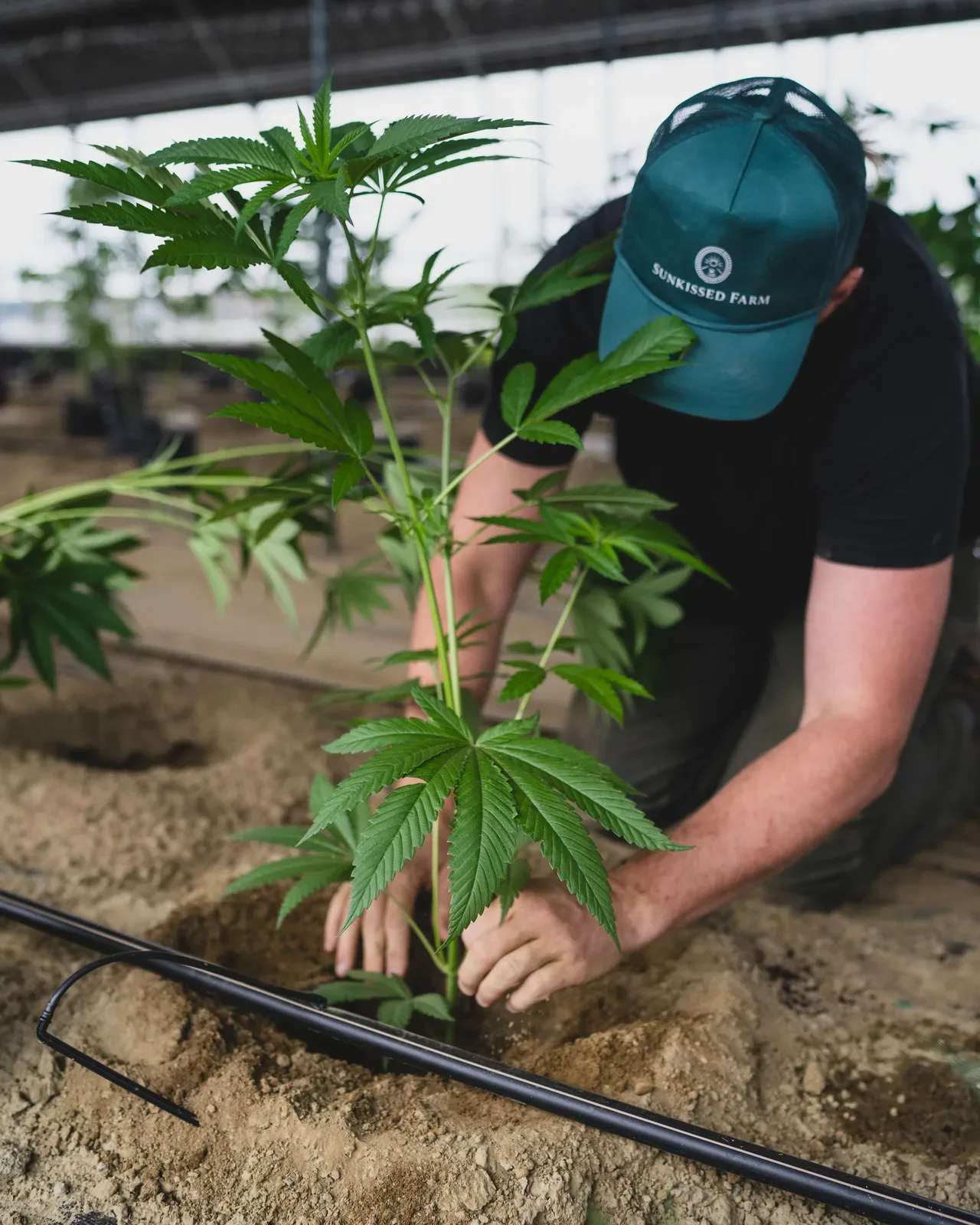
The first in an ongoing series on how Sunkissed Farm cannabis is grown, in the words of the people who grow it. We walked the greenhouses in Windsor, Vermont with head cultivator Brad Macrae to talk about the soil under the beds. What it is, how the farm builds it, and what it does to the plant.
Most of what makes Sunkissed Farm cannabis what it is happens out of sight, underground, before a plant ever flowers. We asked Brad Macrae, who runs the farm's soil program and harvest, to walk through how the farm grows in living soil and why it does it this way.
For the science behind everything described here, see our companion explainer, Living Soil Cannabis: How Microbiology Creates Better Flower. This is the conversation that one came from.
You describe living soil with a sourdough starter. Why that comparison?
Because it makes the whole thing click. A sourdough starter is a living colony. Yeasts and bacteria. You feed it, you keep the moisture and the temperature where they need to be, and the microbes do the actual work. People keep these things alive for generations.
Soil is the same idea, just bigger and more complicated. We're not feeding the plant directly. We're feeding a community of organisms, and that community feeds the plant. Our job is to keep the conditions right and then stay out of the way. Once you see it that way, you stop thinking like someone pouring nutrients into a pot and you start thinking like someone tending a colony.
What does that community actually need from you?
Three things, really. Food, oxygen, and moisture. Get those right and the organisms you want will thrive, and when they thrive they crowd out the ones you don't want. The bad actors can't get a foothold because there's nothing left for them, the good microbes have already taken the food and the space.
Food is carbon, sugars, the complex material that fungi in particular break down. Oxygen comes from structure, the soil has to have gaps and channels for air to move through, which is why compaction is the enemy. And moisture has to sit in a range, not soaked, not bone dry. None of that is exotic. It's just paying attention to what keeps the colony healthy.
A lot of growers till. You don't. Why not?
Every time you till, you tear apart the networks that have been building under the surface, the fungal threads especially. Those take time to establish and they're fragile once you break them. So we go no-till. We put the inputs on top of the beds, and we let the worms, the roots, and the seasons do the mixing. Water, heat, the freeze and thaw over winter, all of that works the material down into the soil for us, slowly, without ripping the system apart to do it.
It's slower than running a tiller through. But the whole point is that the network underneath gets more complex and more stable the less you disturb it. You don't get that if you're tearing it up every season.
Tell me about the soil itself.
The land is an ancient alluvial floodplain, what the Connecticut River laid down over a very long time. Sandy loam, drains well, holds what it needs to. And it had been a dairy farm for around two hundred years before cannabis. Two centuries of cattle and cover and organic matter cycling through.
When we tested it, it came back around eight percent organic material. Anything over four or five is considered high. That's two hundred years of a working relationship between a farmer, his animals, and this piece of ground. That's not something you build in a season or buy in a bag. So the job here was never to fix the soil. It was to maintain it and add to it.

You've talked about shifting the soil toward fungi. What does that mean?
The soil we found had a pastoral profile, a grassland signature, which is what you'd expect after generations of cows grazing it. Good soil. But cannabis does better in a fungal-dominant system, so we've been slowly moving it that direction by feeding the fungi what they want, more woody, organic plant material, the inputs that let them colonize and spread.
Fungi operate at a scale people don't appreciate. The largest living organism on earth is a fungus. Out in Oregon, a single organism covering a few square miles underground. What you see as a mushroom is just the fruiting body. The real organism is this vast network running through the ground. In our beds it's the same principle at a smaller scale: the fungi break down organic material and free up minerals and nutrients that were locked inside it, and then they move those things to the plant. There's research suggesting some of them actually sense what the plant is asking for and pull it from the wider network. The bacteria come in behind and do the secondary breakdown. It's layered. Everything's working on a different part of the job.
So what does that buy the plant?
Access. Cannabis is a heavy feeder and what it needs changes through the season: it's putting on structure early, then it's flowering hard later. A living soil lets it reach for the right thing at the right moment without being forced. It's not waiting on anyone to mix a feed. It's pulling what it needs from a system that already has it.
And a plant that's never stressed for food is a stronger plant. Vermont throws stress at you. A stretch that runs too hot, too much rain at the wrong time. A plant that's been well fed all season has the reserves to take that and keep going. The resilience and the strength to just keep going happily. A plant that's been fighting for nutrients the whole time shows it at harvest.
Can you actually taste the difference?
You can. The same genetics, same seed, grown in a commercial medium versus this soil come out different. In the inert stuff you still get THC, you still get measurable terpenes. But it's more flat. More muted. You're missing the secondary compounds, the minor cannabinoids and the less-abundant terpenes and everything else the plant makes when it has a rich enough environment to make it. The plant only produces what the environment lets it produce.
What we're after is flower that's as good as nature intended, as the plant evolved, and as we can help it to thrive. That's the whole standard. Not adding something. Letting the plant become everything it already knows how to be.
What goes into the soil besides compost?
Compost is the foundation, that's the main input, and we make it here. Cattle manure, plant material off the farm, grasses, woody material, all of it managed so the right microbes grow in it and digest it. There's a heat phase in good composting where the microbes drive the temperature up high enough to sterilize the bad stuff, and after that the worms move in and finish it. That finished compost goes back into the beds. The composting alone generates so much richness that it carries most of the system.
Beyond that we send soil to a university lab and test it, so we're working off real numbers, not guesses. If the test says the soil is short on something, we'll add rock dusts and mineral powders. But those don't get fed to the plant directly. The microbes pre-digest them and make them available. You get to the right place circuitously, through the biology, instead of dumping a soluble nutrient on the roots.
People obsess over pH and NPK. Where does that fit for you?
We still watch it. It's not that we ignore the numbers, we just arrive at them a different way. Our pH is already right where cannabis wants it, so we're not fighting it, and the living system buffers the plant against swings on its own. An indoor or hydro grower has to obsess over pH because they're working in inert media. Whatever they put in hits the roots directly, and if the pH is off the plant locks out and can't absorb anything. We don't have that problem because the system is doing the buffering for us.
And the cover crops?
The plants are in the ground one season. The soil lives year round, so we keep it fed through the offseason with cover crops, and each one does a different job. Vetches fix nitrogen and add diverse material. Grasses give you surface cover and carbon. And then the tubers do the structural work. Radishes, turnips. A daikon radish will drive two feet down, a root a couple inches across, and when it dies and breaks down it leaves a channel running deep into the soil. That fills with compost right where the cannabis roots are eventually going to reach. We don't have to work any of it in. It grows, it dies, the system takes it.
Vermont winters force your hand. How do you work with that?
You work in the windows the season gives you. When it's not frozen, when the composting conditions are right, when there's enough light and warmth. You don't fight the freeze-thaw. You use it. It's part of what mixes the soil for us. The whole practice is paying attention to what's naturally there and working with it instead of against it.
Where does this go in ten years?
Up. That's the part I'd want people to understand about a living system versus a synthetic one. A synthetic program gives you the same result on day one as it does five years in, it's flat. Ours gets better. Every season we add organic material, the microbial profile improves, we've brought the cows back for more manure, and we keep learning what the plant wants at each stage and getting better at providing it. The flower we grow today was grown in a system that's been developing for years. The flower we grow a decade from now will come out of something richer still. That trajectory is what regenerative actually means. It's not a label. It's the direction the soil is heading.
If you had to put the whole philosophy in a sentence?
It's really a process of not breaking what is ecologically perfect and just introducing all the right ingredients. We didn't invent this soil. We inherited two hundred years of it. The work is keeping it alive and feeding it well, and then trusting the plant to do the rest.
This conversation has been edited for length and clarity. For the research and full breakdown of how living soil shapes terpenes, cannabinoids, and the finished flower, read Living Soil Cannabis: How Microbiology Creates Better Flower. To understand how Vermont's growing environment shapes the plant, see Vermont Cannabis Terroir.
Sunkissed Farm is an artisanal cannabis farm in Windsor, Vermont. Visit our dispensary at 4374 West Woodstock Road, Woodstock, Vermont, open seven days a week. Reach us at hello@sunkissed.farm or 802-222-6920.
This piece is a first-person interview. The claims are Brad Macrae's, drawn from his cultivation experience at Sunkissed Farm. For the supporting research, see the companion article Living Soil Cannabis: How Microbiology Creates Better Flower.
Who is Brad Macrae?
Brad Macrae is the head cultivator at Sunkissed Farm in Windsor, Vermont. He has roughly two decades of experience with medicinal plants, including organic herb farming, extraction, and clinical formulation work across more than a hundred plant varieties, and he runs the farm's soil program, harvest, and in-house breeding program.
What is living soil cannabis?
Living soil cannabis is grown in a biologically active medium: soil containing fungi, bacteria, earthworms, and other organisms that break down organic material and deliver nutrients to the plant. Rather than feeding the plant directly with synthetic inputs, the grower feeds the soil ecosystem, and the ecosystem feeds the plant on demand.
Why does Sunkissed Farm practice no-till?
Tilling tears apart the fungal networks and microbial communities that develop below the soil surface, which take time to establish and are fragile once broken. Sunkissed Farm introduces inputs on top of the beds and lets worms, roots, and seasonal freeze-thaw incorporate them naturally, preserving the biological network that makes living soil work.
Does living soil change how the cannabis tastes?
According to Brad Macrae, the same genetics grown in commercial medium versus living soil come out noticeably different. Inert media still produce THC and measurable terpenes, but the result is, in his words, "more flat, more muted," missing the minor cannabinoids, secondary terpenes, and other compounds a plant only produces when its soil environment is rich enough to support them.
What is a fungal-dominant soil profile and why does it matter for cannabis?
A fungal-dominant soil has a higher proportion of fungal activity than bacterial. Sunkissed Farm started with a pastoral, grassland-type profile left by 200 years of dairy grazing and has shifted it toward fungal dominance by adding woody, organic material. Fungi break down organic matter, free up bound nutrients, and transport water and minerals directly to plant roots, which cannabis, a heavy feeder, benefits from throughout its growth cycle.
Where can I read more about the science of living soil?
Sunkissed Farm's companion article, Living Soil Cannabis: How Microbiology Creates Better Flower, covers the microbiology, research citations, and soil-to-jar breakdown in full. This interview is the primary-source conversation that article was built from.