Why Sunkissed Farm grows every cannabis plant from seed. F1 hybrid breeding, HLVd disease resistance, and genetic diversity in Windsor, Vermont.
If you’ve bought cannabis from a dispensary in the last few years, almost every flower you’ve tried was grown from a clone. A cutting taken from a mother plant, rooted, and grown into a genetic copy. It’s the standard. It works. And it comes with tradeoffs that most consumers never hear about.
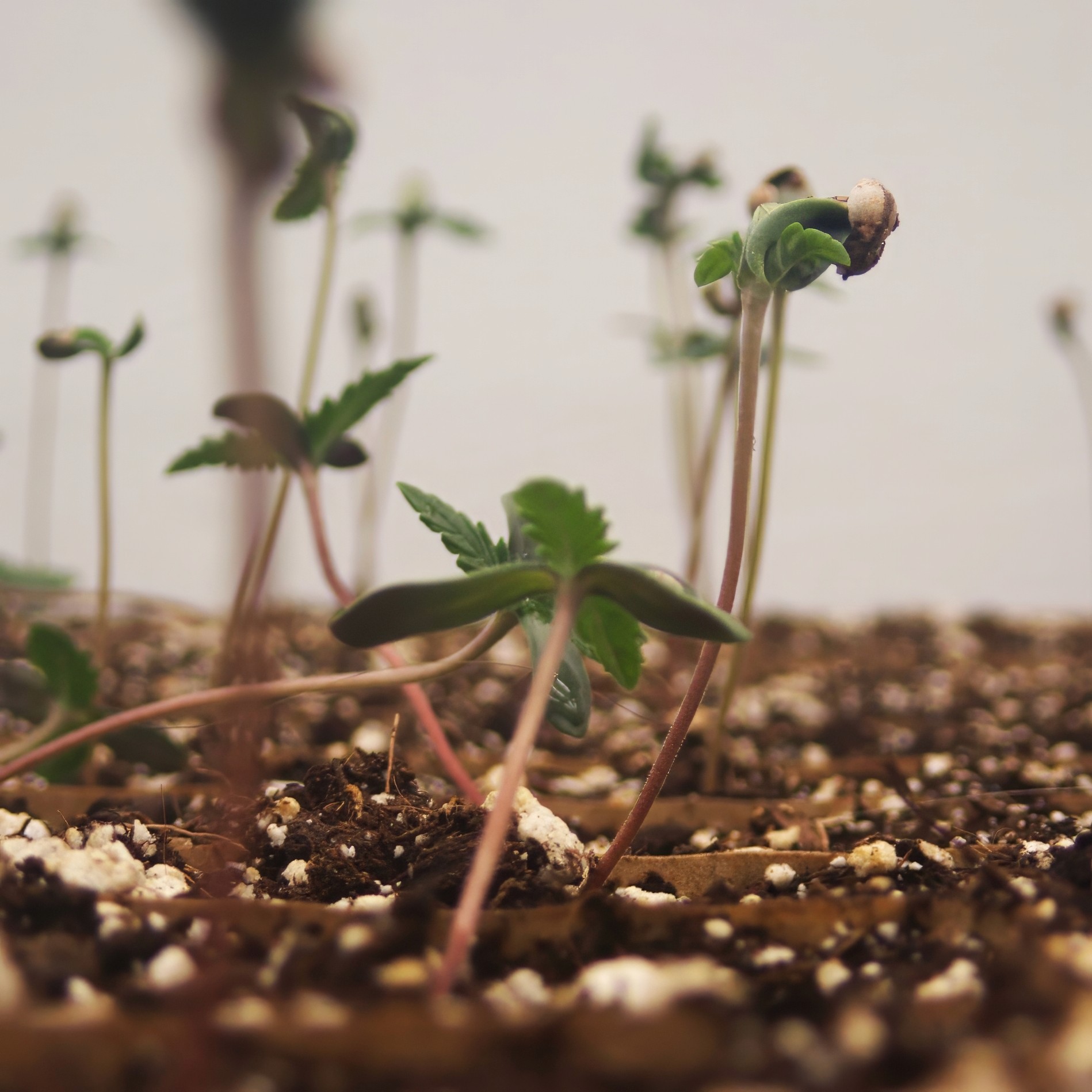
The alternative is growing from seed, where each plant carries a unique genetic combination from two parents. It’s how agriculture worked for thousands of years before cloning became commercially convenient. It’s also how every varietal in the Sunkissed catalog was developed, because you can’t breed anything new from a copy.
This isn’t an argument that clones are bad. It’s an explanation of what changes when a farm chooses seed instead, and why that choice shapes the flower you take home.
How cloning works and why the industry relies on it
A clone is a branch cut from an existing cannabis plant and rooted to grow as an independent organism. The new plant carries the exact same DNA as the original. Every clone from the same mother is genetically identical, which means they flower on the same timeline, produce the same cannabinoid ratios, and finish at the same size. For operations running thousands of plants through a standardized harvest schedule, that predictability is the entire point.
The tradeoff is that cloning is a closed genetic loop. No new traits are introduced. No adaptation occurs. The plant you harvest five years from now is genetically identical to the one you harvested today. If the mother carried a vulnerability, whether to mold, heat stress, or a particular pathogen, every clone inherits it.
Think of it this way. A clone is a photocopy. A seed is a new individual.
What growing from seed actually changes
A seed carries a unique genetic blueprint from two parent plants. Even seeds from the same cross are genetically distinct from one another, the same way siblings share parents but aren’t identical. Every plant is an individual with its own expression of terpenes, cannabinoids, growth structure, and environmental response.
For a farm focused on quality rather than uniformity, that variation is the point. It’s what makes a breeding program possible. You grow hundreds of seeds from a cross, evaluate what each plant produces, and select the individuals that express the traits you’re after, whether that’s a specific terpene profile, a growth habit suited to Vermont’s short season, or resilience to the humidity that comes off the Connecticut River in August.
That selection process is how our varietals exist. Tropical Smoothie, a true sativa with myrcene, limonene, and bisabolol dominance that tastes like mango and pineapple, came from growing out hundreds of Citrus Smoothie and Velvet Pie seeds and choosing the standout individuals. That process can’t happen with clones. Clones reproduce what already exists. Seeds create what doesn’t exist yet.
The disease problem nobody wants to talk about
Hop latent viroid, or HLVd, is the most significant disease threat facing commercial cannabis in North America. It’s a tiny circular RNA molecule, 256 nucleotides long, that spreads through physical contact: contaminated scissors, shared cloning trays, recirculated water, gloves. Research from Simon Fraser University found that 25% of cannabis samples tested across Canada between 2020 and 2023 were positive for HLVd. In California, industry surveys have estimated that 90% of facilities are infected.
The symptoms are exactly what you’d expect from a pathogen that degrades the plant’s chemistry: stunted growth, reduced trichome production, diminished terpene expression, and yield losses that can reach 50% or more. Plants can carry the viroid silently for weeks before symptoms appear, spreading it through a facility before anyone knows it’s there.
Here’s the structural problem. Clones are produced by cutting from a mother plant. If the mother carries HLVd, every clone she produces is infected from day one.
Research on F1 hybrid seeds from infected parent stock found that the viroid does not readily transmit through seed. Starting from seed effectively resets the disease clock. It’s not a guarantee, but it’s a structural advantage that clone-dependent operations don’t have.
Sunkissed Farm has never had an HLVd detection. That’s not an accident. It’s a consequence of never relying on the shared cuttings and mother-plant rooms where the viroid thrives.
What F1 hybrids are and why we breed them
Every varietal in our catalog is an F1 hybrid, the first-generation offspring of a cross between two distinct parent lines. F1 hybrids exhibit what geneticists call hybrid vigor, or heterosis: the offspring tend to be more vigorous, more resilient, and more productive than either parent alone. This isn’t unique to cannabis. It’s the foundation of modern agriculture, from corn to tomatoes to the heritage apple trees in any Vermont orchard.
The practical result is varietals bred for specific outcomes.
Laced Cookies, a sativa-dominant cross of Durban Poison and Purple Velvet Cookie, is dominated by terpinolene, myrcene, and ocimene. It was selected for focused, daytime energy at a moderate 22-25% THC, the kind of experience you’d want for a Saturday morning hike up Mount Tom.
Purple Rocket Pop, an indica-dominant cross of Velvet Pie and Gastro Pop, leads with limonene, beta-caryophyllene, and linalool. Deep relaxation and appetite stimulation at 23-26% THC. A completely different experience from a completely different genetic architecture, developed in the same breeding program, grown from seed in the same living soil.
Zpritzer, a sativa-dominant Velvet Pie and Mellows cross, was selected specifically for daytime functionality: mild, active, focused effects with a sour, peach, soda flavor profile. This kind of precision, selecting not just for potency but for the specific combination of effects and terpenes that serve a particular moment in someone’s day, is what a seed-based breeding program makes possible.
What the genetics research actually shows
A 2021 study published in Nature Plants genotyped over 100 cannabis samples for more than 100,000 genetic markers and found that terpene profiles are strongly associated with genetic variation in terpene synthase genes. The terpenes that shape how cannabis smells, tastes, and feels are substantially determined by the plant’s DNA, not just its growing environment.
This is why starting from seed matters for quality. When you clone, you’re locked into whatever terpene synthase genes the mother plant carries. When you breed from seed, you can select across the full range of genetic variation, choosing the individuals whose terpene expression matches what you’re trying to create.
The same study found something else worth noting: sativa and indica labels are “genetically indistinct on a genome-wide scale.” The names don’t predict the plant’s chemical output. What does predict it is the specific combination of terpene synthase genes each individual carries. This is the framework we use at Sunkissed, varietals described by their dominant terpenes and effects, not by categories that the science has moved past.

The honest case for clones
Cloning has real advantages and it’s worth being direct about that. A proven clone delivers predictable results on a known timeline. For a large commercial operation running tight margins on a harvest schedule, that consistency has genuine value. Tissue culture, a laboratory technique for producing pathogen-free clones, has addressed some of the disease transmission problems, though it requires significant infrastructure and expertise that most small farms don’t have.
The limitation isn’t that clones are bad. It’s that they can’t do what seeds can. They can’t introduce new traits. They can’t adapt to a specific growing environment over time. They can’t provide the raw material for a breeding program. And they can’t escape the fundamental vulnerability of genetic monoculture: when every plant in a facility is the same organism, a single pathogen that defeats one plant defeats all of them.
Vermont’s apple orchards learned this lesson generations ago. A hillside planted with a single apple variety is one bad blight away from total loss. A diverse orchard is resilient. The same principle holds underground in a cannabis greenhouse.
Why this matters at the dispensary counter
The practical difference for someone walking into a Vermont dispensary is this: flower grown from seed in a serious breeding program tends to have more complex terpene profiles, because the breeder is selecting across a wider range of genetic expression. It tends to have stronger environmental resilience, because each plant has a unique genetic toolkit for responding to stress. And it tends to come from healthier stock, because seed propagation doesn’t carry the disease transmission risks of shared cuttings.
None of this guarantees that seed-grown cannabis is always better than clone-grown cannabis. Growing conditions, soil health, harvest timing, and cure process all matter enormously. A well-grown clone in good soil can outperform a poorly managed seed plant. But when the growing conditions are equal, the genetic diversity and breeding potential of seed propagation gives the plant more to work with.
At Sunkissed, the combination of seed-based genetics, living soil, and Vermont’s natural growing environment is designed to let each plant become the fullest expression of its genetics. The soil feeds the biology. The sun drives the photosynthesis. And the seed carries a genetic blueprint that has never existed before.
How to ask about it
If you’re curious about how the cannabis you buy was propagated, here are a few questions worth asking at any dispensary.
Was this grown from seed or clone? Most commercial cannabis is cloned. Seed-grown is less common and usually indicates a smaller operation with an active breeding program.
Does the farm breed its own varietals? Proprietary genetics developed through a breeding program are different from purchasing seeds or clones from a third-party supplier. The farm that breeds its own lines controls the genetic quality from the beginning.
Has the facility tested for HLVd? Any operation taking disease prevention seriously should be testing regularly. Seed-based operations have a structural advantage, but testing matters regardless of propagation method.
What are the dominant terpenes in this varietal? This tells you more about the expected experience than any sativa or indica label. If the budtender can tell you the terpene profile and what it was selected for, that’s a farm that knows its genetics.
Sunkissed Farm is an artisanal cannabis farm in Windsor, Vermont. Every plant is grown from seed in living soil under natural light. Visit our dispensary at 4374 West Woodstock Road, Woodstock, Vermont, open seven days a week. Reach us at hello@sunkissed.farm or 802-222-6920.
Frequently Asked Questions
What is the difference between cannabis grown from seed and cannabis grown from a clone?
A seed carries a unique genetic combination from two parent plants, making every seed-grown plant genetically distinct. A clone is a cutting taken from an existing plant, producing an exact genetic copy. Seed-grown cannabis allows for breeding programs, genetic diversity, and natural adaptation to specific growing environments. Clones offer predictability and consistency but no new genetic variation. Most commercial cannabis is clone-grown. Seed-based cultivation is less common and typically indicates a farm with an active breeding program.
Why does Sunkissed Farm grow every plant from seed?
Sunkissed Farm grows from seed because it runs an in-house breeding program that develops proprietary F1 hybrid varietals bred for specific terpene profiles, effects, and growing characteristics suited to Vermont’s climate. Growing from seed provides the genetic diversity necessary for selective breeding, produces plants with hybrid vigor, and avoids the disease transmission risks associated with shared clone stock, particularly hop latent viroid. Every varietal in the Sunkissed catalog, from Tropical Smoothie to Purple Rocket Pop, was developed through this seed-based selection process.
What is hop latent viroid and why should I care about it?
Hop latent viroid (HLVd) is a 256-nucleotide RNA pathogen that spreads through physical contact, contaminated tools, and shared water systems. Industry surveys have found infection rates as high as 90% in California facilities and 25% across Canadian operations. Infected plants produce less flower with diminished terpene profiles and reduced potency. Because clones are produced by cutting from mother plants, an infected mother passes the viroid to every clone. Research indicates that HLVd does not readily transmit through seed, which is one reason seed-based farms like Sunkissed have a structural advantage in disease prevention.
What is an F1 hybrid cannabis varietal?
An F1 hybrid is the first-generation offspring of a cross between two genetically distinct parent lines. F1 hybrids typically exhibit hybrid vigor (heterosis), meaning they tend to be more vigorous, resilient, and productive than either parent. This is the same principle behind hybrid corn, hybrid tomatoes, and most modern crop agriculture. All Sunkissed Farm varietals are F1 hybrids bred in-house from selected parent lines for specific terpene profiles, effects, and growing characteristics suited to Vermont’s short northern growing season.
Does growing from seed mean the cannabis is less consistent?
Seed-grown cannabis from a stabilized breeding program produces consistent results within a varietal, though individual plants will have subtle natural variation. This is similar to how heritage apple trees from the same orchard produce apples with a recognizable character, even though no two are perfectly identical. The consistency comes from the breeding program’s selection work over generations, not from genetic uniformity. Many cultivators and consumers consider this natural variation a mark of craft cultivation rather than a drawback.
How do genetics determine terpene profiles in cannabis?
A 2021 study published in Nature Plants genotyped over 100 cannabis samples and found that terpene profiles are strongly associated with genetic variation in terpene synthase genes. The terpenes that shape aroma, flavor, and effects are substantially determined by the plant’s DNA. Breeding from seed allows selection across the full range of terpene synthase gene variation, while cloning locks the grower into whatever terpene genetics the mother plant carries. This is why seed-based breeding programs can develop varietals with specific, targeted terpene profiles.